
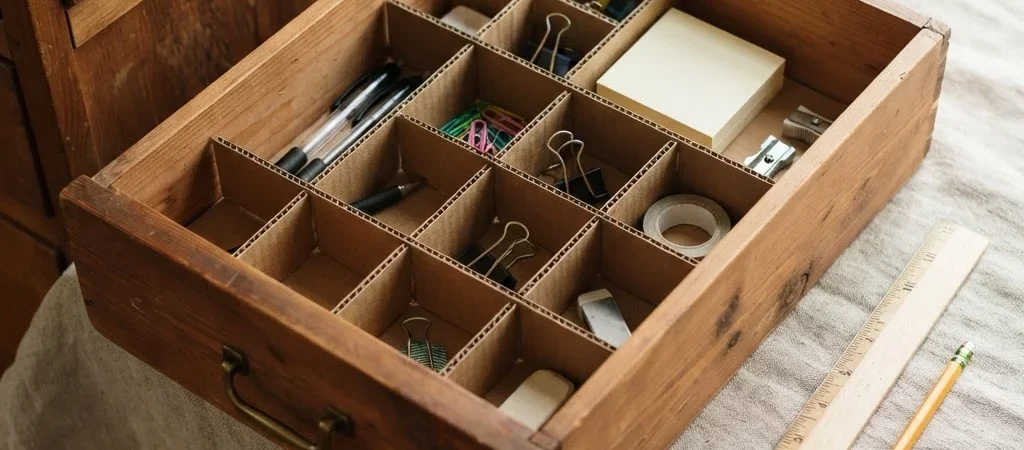
The frustrating part of a junk drawer is often not the number of things in it, but how they slide into one another. Before buying organizers, try making dividers from a clean cardboard box. The layout can follow your drawer and its contents instead of asking both to fit a standard tray.
Measure before you cut
You’ll need corrugated cardboard, a ruler, a pencil, scissors or a craft knife, and paper tape. Empty the drawer and measure its inside length, width, and height; leave a little clearance so the finished dividers can be lifted out easily. Sort the drawer’s contents into a few groups, then sketch a simple grid that gives the most-used items room to lie flat.
Cut cardboard strips to the drawer’s inside height, checking each one against the space before making the rest. For a crosspiece, measure the distance between the strips it will join. The cardboard should sit snugly, not bow outward against the drawer walls.
Join the pieces with notches
Mark each crossing point on the strips. Cut a notch halfway down one strip and halfway up the strip that meets it; make each notch as wide as the cardboard is thick. Test the pieces together on a flat surface, and widen a notch a little at a time if the joint will not slide into place.
Fit the joined grid into the drawer and check that it sits level. If the strips shift, secure their intersections with short pieces of paper tape. Trim any edge that catches, rather than forcing the grid into the drawer.
Make the layout useful
Put the longest or most frequently used items in the largest compartments, and keep small loose things in a section that is easy to reach. Try the arrangement for a few days before decorating anything; a divider is only helpful if it matches how the drawer gets used. When the layout feels right, cover the cardboard with kraft paper or leftover wrapping paper, or leave it plain.
This is a quick fix for light household items such as pens, clips, or spare batteries, not a rigid organizer for heavy tools or damp spaces. If the drawer changes purpose, pull out the grid and adjust the strips instead of starting from scratch. Keep the cardboard offcuts; they can become spacers for the next drawer.